Volume 32. October 17, 2022
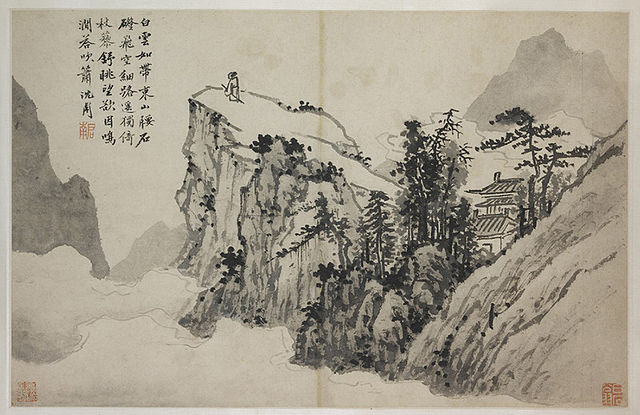
Han Shan (“Cold Mountain”) was a Chinese Buddhist figure associated with a collection of poems from the Tang Dynasty. When he lived, who he was, and whether he existed is a mystery.
Apparently, he lived alone in an empty cave on Cold Mountain, following the Way, harmonizing with the eternal Tao, meditating. He spent his days in seclusion and simplicity, writing poems.
Here is a sample of his work:
In my house there is a cave,
and in the cave is nothing at all —
pure and wonderfully empty,
resplendent, with a light like the sun.
A meal of greens will do for this old body,
a ragged coat will cover this phantom form.
Let a thousand saints appear before me —
I have the Buddha of Heavenly Truth.
Buddhism is an attempt to describe the Indescribable, to tell the Untellable, to fathom the Unfathomable, to say the Unsayable. Buddhism is a realization of Oneness.
But beware of making Oneness an idea. It’s not something that can be rationalized, compartmentalized and categorized.
Oneness is a reality that can only be experienced, intuitively, for each individual by himself or herself.
Once a student said, “I’ve been reading that Jesus and Buddha were enlightened individuals, but their enlightenment was different.”
That’s impossible.
Perhaps their expression of enlightenment was different, but not the actual experience.
Enlightenment is a sudden, tacit understanding of the non-dual nature of reality.
Oneness is One, not Two.
That student was under the impression that in meditation something happens. You magically morph from monster to master. Meditation somehow transforms titmice into titans.
The truth is, in meditation, nothing happens.
In meditation, one realizes the Wallpaperness of Whatever-Is-Before-Your-Face, the Actual Sameness, the Perpetual Potential, the Golden October Radiance, the This-Cannot-Be-Taught-ness.”
Words cannot go there. The tongue cannot touch it. To pollute Prajna with thoughts and labels and categories is to slander it.
The world is full of noise. Silence is the perfect sound.
If you want suffering, there’s plenty more where that came from.
But in Buddhism, boredom is bliss.
Someday, it will all end up on Cold Mountain, like Han Shan, in silence, in simplicity, in radiance, in bliss … in Oneness.
And when that happens, despite whatever religion you follow, you too will have the Buddha of Heavenly Truth.
 The Buddha Times
I really liked, “But beware of making Oneness an idea. It’s not something that can be rationalized, compartmentalized and categorized.”
That is absolutely one of my current challenges. Thanks for the tip!
LikeLike