
VOLUME 55. SEPTEMBER 17, 2024
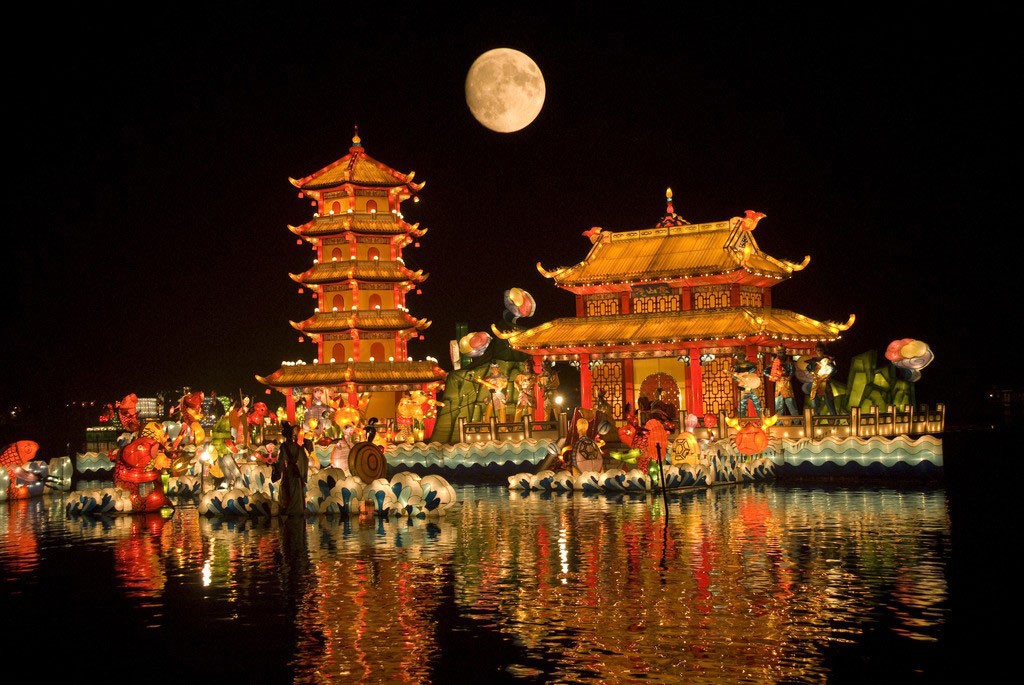
Once upon a time, an archer loved his beautiful wife. She was bothered by the unbearable heat of ten suns scorching the land.
So, the archer shot down nine of them. For his meritorious deed, Heaven rewarded him with the elixir of immortality.
The archer’s wife, however, mistakenly consumed the elixir.
She became weightless. She floated skyward.
She couldn’t bear to be without her husband. So, to be close to her beloved, she chose the Moon for her immortal home.
When the archer discovered what happened, he felt responsible. Missing her dearly, he longed to get a glimpse of her.
So, in September, when the moon was at her fullest, he offered fruits and small cakes to her pale white radiance. Sitting there quietly in the moonbeams, he felt her love once again.
The End
This delightful and romantic legend of the moon goddess hails from China and inspires people all over Asia to celebrate the beauty of this time of year.
The full moon of September marks the Mid-Autumn Festival.
This ancient harvest holiday features husbands, wives and children coming together and, as families, feasting on the star of any Mid-Autumn Festival, a calorie-packed pastry called the moon cake.
There’s nothing Buddhist at all about the Mid-Autumn Festival, but the beauty of the moon once inspired the Buddha himself.
When trying to put the Wordless into words, the Buddha uttered a memorable metaphor: “I’m just a finger pointing at the moon.”
In other words, Buddhist wisdom, philosophy and ethics are fine, but they don’t constitute enlightenment.
The true Dharma is beyond words, beyond thoughts.
It’s right here and right now. Accessible at any moment.
Behold the beauty of the moon.
In old China, Zen master Huang-po (d.866) intuited this truth. Enlightenment is not found in doctrines, but in Thusness.
Huang-po phrased it this way:
“All this talk of Bodhi, Nirvana, the Absolute, Buddha-nature, Mahayana, Theravada, Bodhisattvas and so on is like mistaking autumn leaves for gold.”
The true nature of all things is a perfect Oneness. When we sit in silent meditation, we experience this tranquil unity. Intangible yet within our grasp, the true Dharma is always before us.
Huang-po lamented, “Ah, this Dharma of Thusness — until now so few people have come to understand it.”
So few people, except for one who sits quietly in the moonlight and munches mindfully on a mooncake.
 The Buddha Times