
Volume 64. June 13, 2025
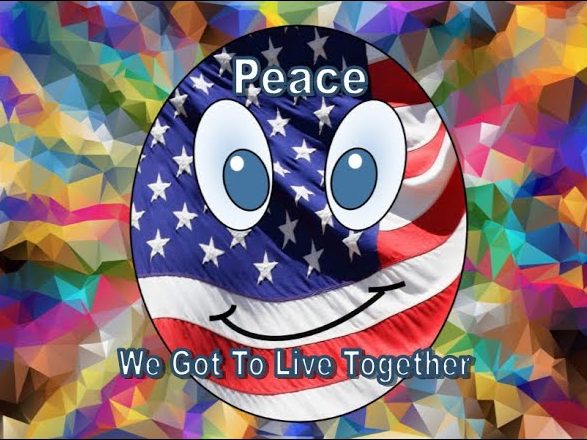
Sing it with me: “Ooh, sha-sha. We got to live together!”
Sly and the Family Stone enjoyed a chart-topping single (“Everyday People”) in 1969 that proclaimed a musical vision of human equality.
The song’s verses mocked the futility of people hating each other for being tall, short, rich, poor, fat, skinny, white or black, while its exuberant refrain declared, “I am everyday people.”
Sly Stone died on June 9 in Los Angeles. In an ironic coincidence, his idealism was reincarnated in anti-ICE protests that began in Los Angeles and have spread across the country.
Hundreds of thousands of everyday people have marched to decry the Trump administration’s heavy-handed immigration crackdown.
The impasse between immigrant-haters versus upholders of human dignity seems unbridgeable. How can we live together?
Buddhism points the way with a simple analogy.
Consider a coin. One side is covered with an infinite number of dots representing the endless dualisms that make up our world: tall/short, rich/poor, black/white. This is the world of samsara.
Now turn the coin over. The other side is completely blank. All things are identical and non-dual. This is the world of nirvana.
The two worlds are one world. Everything present on the busy side of the coin is encompassed within the blank side. In the non-dual world of nirvana, distinctions are wiped out.
Because of this underlying unity, all things share in one another’s non-dual identity.
All things are Buddha-nature.
Watching the news, we become engrossed in dualistic distinctions: National Guard/protesters, immigrants/citizens, right/wrong, ICE agents/deported husbands, smug presidents/weeping mothers.
When seen with the True Dharma Eye, we behold all these dualistic distinctions as one.
It’s all Buddha-nature.
Bodhidharma, the legendary founder of the Zen school, phrased Buddhist truth this way:
When your mind doesn’t arise inside,
the world doesn’t arise outside.
Buddhism offers an outlook that balances samsara and nirvana, dualism and non-dualism — two contradictory views of reality — and prevents either side from becoming too dominant.
Buddhism is the Middle Way. It takes the path between extremes.
The doctrine of non-duality helps us view the world in its proper perspective. The world is one despite its noxious differences.
When we avail ourselves of the True Dharma Eye, we do not abandon the world, but we do see the world in its purity.
At that point, we bickering humans can come together in harmony, like Sly Stone’s multi-racial, multi-gender band. Despite our differences, we too can make beautiful music together.
“Ooh, sha-sha.”
 The Buddha Times