HAPPY MID-AUTUMN FESTIVAL!

VOLUME 55. SEPTEMBER 17, 2024

Once upon a time, an archer loved his beautiful wife. She was bothered by the unbearable heat of ten suns scorching the land. 

So, the archer shot down nine of them. For his meritorious deed, Heaven rewarded him with the elixir of immortality. 

The archer’s wife, however, mistakenly consumed the elixir.

She became weightless. She floated skyward. 

She couldn’t bear to be without her husband. So, to be close to her beloved, she chose the Moon for her immortal home. 

When the archer discovered what happened, he felt responsible. Missing her dearly, he longed to get a glimpse of her. 

So, in September, when the moon was at her fullest, he offered fruits and small cakes to her pale white radiance. Sitting there quietly in the moonbeams, he felt her love once again. 

The End

This delightful and romantic legend of the moon goddess hails from China and inspires people all over Asia to celebrate the beauty of this time of year. 

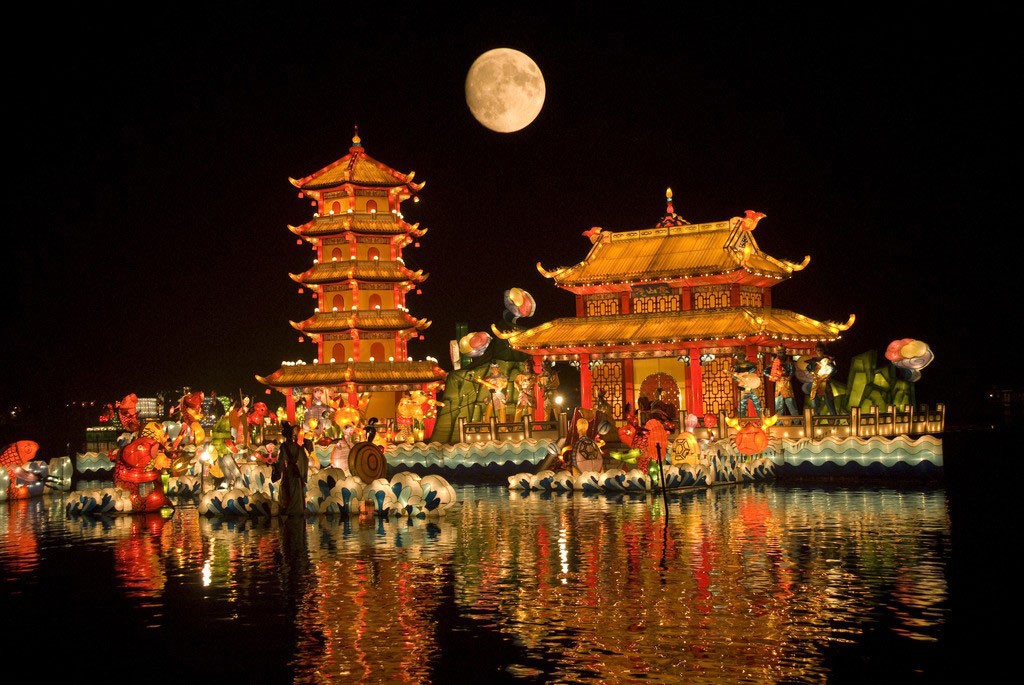
The full moon of September marks the Mid-Autumn Festival. 

This ancient harvest holiday features husbands, wives and children coming together and, as families, feasting on the star of any Mid-Autumn Festival, a calorie-packed pastry called the moon cake. 

There’s nothing Buddhist at all about the Mid-Autumn Festival, but the beauty of the moon once inspired the Buddha himself. 

When trying to put the Wordless into words, the Buddha uttered a memorable metaphor: “I’m just a finger pointing at the moon.” 

In other words, Buddhist wisdom, philosophy and ethics are fine, but they don’t constitute enlightenment. 

The true Dharma is beyond words, beyond thoughts. 

It’s right here and right now. Accessible at any moment. 

Behold the beauty of the moon.

In old China, Zen master Huang-po (d.866) intuited this truth. Enlightenment is not found in doctrines, but in Thusness.     

Huang-po phrased it this way: 

“All this talk of Bodhi, Nirvana, the Absolute, Buddha-nature, Mahayana, Theravada, Bodhisattvas and so on is like mistaking autumn leaves for gold.” 

The true nature of all things is a perfect Oneness. When we sit in silent meditation, we experience this tranquil unity. Intangible yet within our grasp, the true Dharma is always before us.

Huang-po lamented, “Ah, this Dharma of Thusness — until now so few people have come to understand it.” 

So few people, except for one who sits quietly in the moonlight and munches mindfully on a mooncake. 

Biden’s Gracious Bow

Volume 54. August 3, 2024

On July 21, 2024, after a tortuous decision, President Joe Biden graciously bowed out of his reelection campaign.

He announced, “I’ve decided the best way forward is to pass the torch to a new generation.”

What a lesson in humility!

Imagine being the most powerful person on the planet, then voluntarily, on your own free will, giving up all that power.

Most mortals could not do it. Most would kick and scream. Some might even incite an insurrection and unleash a murderous mob to hold on to presidential power.

There is no force more tenacious than one’s ego. The tornado of personal desire can obliterate anything in its path.

Yet, Buddhism believes there is no ego. Buddhism urges us to let go of ego-desires and replace them with selfless compassion.

This aspiration to redirect selfish behavior is beautifully expressed in an old Tibetan verse:

Whenever I am with others, I will see myself as the lowest of all and, from the depths of my heart, respect them as the highest.”

Such a noble sentiment obviously is difficult to put into practice.

But many centuries ago a Tibetan monk gave it a try.

One day, Geshe Ben was sitting in a large gathering of disciples. During a break in the proceedings, yogurt was offered to the guests. Geshe Ben, sitting in the middle, noticed how much yogurt the guests in the first row were taking.

The hungry monk wondered whether he would get his fair share.

Suddenly, realizing his self-centered thoughts, he reprimanded himself. “You yogurt addict!” He turned his bowl upside down.

When the yogurt finally came round to him, he refused saying, “My bad thoughts have already taken their share.”

Whether it be yogurt or ultimate global power, egotistical desires cause needless suffering for ourselves and other people.

For peace of mind, we need to let them go.

It takes wisdom to understand the principle of egoless-ness.

It takes humility to put it into action.

Yet, when we let go of our ego, we gain a new perspective. We see that all life, all things, indeed all people are really interconnected.

We are all in this together.

Joe Biden phrased the Buddhist wisdom of interconnectedness this way:

“It’s not about me. It’s about you, your families, your futures. It’s about we the people, and we can never forget that.”

President Joe Biden, in a Sunday stand down that astonished the nation, displayed the Buddhist ability to let go.

Joe Biden had the humility to pass the torch to a new generation.

Do you?

Happy Fourth of July Buddha-style

Volume 53. July 4, 2024

Happy birthday, America! It’s time to celebrate.

Founding Father John Adams thought Independence Day should be celebrated “with Pomp and Parade, with Shows, Games, Sports, Bells, Bonfires and Illuminations from one End of this Continent to the other.”

He didn’t mention music, but that hasn’t stopped songwriters.

Even classic rock ’n rollers sing patriotic anthems.

Bruce Springsteen belts out, “Born in the USA!”

John Mellencamp wails, “Ain’t that America for you and me.”

John Fogerty hollers, “Some folks are born made to wave the flag. Hoo, they’re red, white and blue.”

Birthdays are important. They mark milestones of time and progress.

How does one celebrate the historical Buddha’s birthday?

Japanese Zen Master Hakuin (d. 1769) lit some incense.

Bowing, he offered it to the Buddha statue in his temple shrine, then he turned to the assembly and gave these instructions:

There’s a young fellow in my house. He’s got no face at all.

A dark little boy from India. We’re celebrating his birthday.

He’s a strapping lad. He’s noble and very strong.

But if you start thinking about him, he’s gone in a flash.

In art, the historical Buddha is depicted as the perfect man, with 32 characteristic marks, like blue-black hair, and 80 minor marks of physical excellence.

He’s superior to people, possessed of great strength and ability.

In truth, this depiction is misleading.

Buddhist wisdom teaches that whatever has form, whatever our senses can apprehend, resembles an illusion.

The 32 signs and 80 excellencies belong to the sphere of matter. Material forms are illusions. The Buddha has no face.

Because the Buddha has no face, if you try to approach him through forms or concepts, he slips beyond your reach and is gone.

Rather, we behold the Buddha in meditation.

When we let things be, when we rest in tranquility, when we set aside conceptual thinking, the Buddha is there.

Once you reach the age of 248, like America does today, you begin to consider estate planning. What should I leave my descendants?

Money? They will only squander it.

Books? They will never read them.

A far better legacy is a model of virtuous behavior.

Secretly increase your practice of morality, meditation and wisdom.

That’s a gift that will last forever.

That’s also something your loved ones will celebrate with Bonfires and Illuminations from one End of this Continent to the other.

Why Do You Have To Lie?

Volume 52. June 5, 2024

For the first time in American history, a former president of the United States has been found guilty (34 times!) of criminal activity. On May 30, 2024, Donald Trump became a convicted felon. 

In a rambling, incoherent speech the next morning, Trump spewed invective at the judge, the witnesses and the prosecutors. 

He displayed no contrition, no humility, no admission of guilt.

Only contempt, defiance and spite. 

Yet, he was able to reflect on his ignominious achievement. 

In a brief moment of clarity and rare introspection, he said, “Falsifying business records … that sounds so bad to me.” 

It sounds bad because it is bad.

Simply put, falsifying business records means not telling the truth. In a word, lying.  

The Buddha considered telling the truth so important that he included Right Speech as one facet of the Eightfold Path. 

In the Pali Canon, the historical Buddha defines Right Speech.  

He asks, “What is right speech? Abstain from lying, divisive talk and abusive rants. This is called right speech.”

He continues, “Speak words that do not torment or harm others. Speak only pleasant words.”

“Before you speak, reflect: Will my words hurt someone? Will I speak gently or harshly? Will I speak with a kind heart or with  inward malice?”

“While you are speaking, reflect: Are my words hurting someone? Am I speaking gently or harshly? Am I speaking with a kind heart or with inward malice?” 

“After you speak, reflect: Did my words hurt someone? Did I speak gently or harshly? Did I speak with a kind heart or with inward malice?”

“If your words have happy results, then you will be joyful.” 

Others will be joyful too.

Lying hurts people. It’s a sign of delusion and the desire to delude others. Right Speech means if you don’t have anything good to say, don’t say anything at all. 

In a grander sense, all words are lies. The Buddha came to this realization. The first words he spoke after enlightenment were: “This cannot be taught.”

To speak of it is to slander it. 

The Absolute cannot be conveyed in words. Yet, to help others reach enlightenment, he had to use deluding lies, that is, words.  

The Buddhist poet Ashvaghosha phrased the quandary this way: “We use words to get free of words until we get to the Wordless.” 

So, if we must use words, let’s use Right Speech. 

Then, all our verbal acts will be found not guilty. 

A Poignant Moment

Volume 51. May 15, 2024

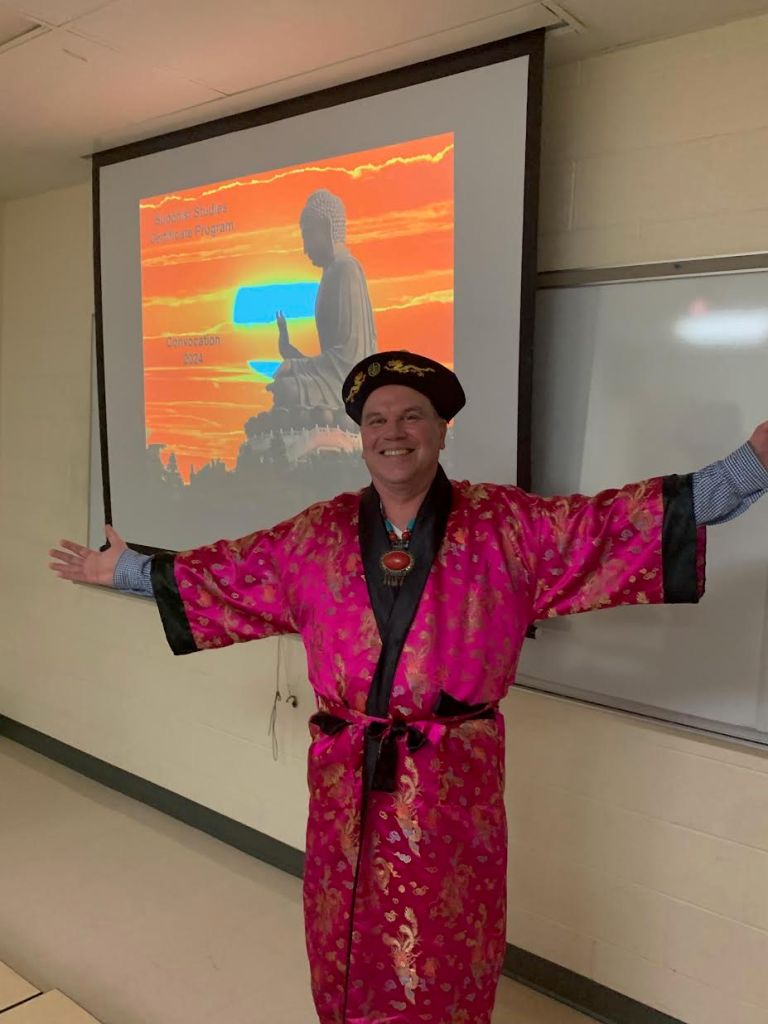
My friends, we have reached a poignant moment. This moment marks the end of the Buddhist Studies Certificate Program at University of Wisconsin-Milwaukee at Waukesha.

What started in India in 500 BC, what spread across Asia for millennia, what ended in Tibet in 1959, will continue after we are gone. Buddhism, like love, is eternal. But the Buddhist Studies Program at our school ends here and now.

Like most things in life, I look on it as a koan. It’s a problem that can’t be solved through rational thinking.

In twelve months, our campus will close. These buildings and hallways and classrooms will become a ghost town.

Twenty years of teaching has truly been a labor of love.

At this poignant moment, I recall the words of the Japanese Zen Master Ryokan (d.1831).

I’m so aware that it’s all unreal.

One by one, the things of this world pass on.

But why do I still grieve?

We can take solace in Buddhist truth: All things are impermanent. All things are without a self.

On a happy note, our friendships will endure. The unexpected blessing of this program was the people we met and the community we built.

I am grateful that together we have done some good in the world.

Where do we go from here? I have no idea.

But did you know that the middle word in Life is If ?

The world is open to new possibilities. When one evening draws to a close, there is always a new day. Be open to new horizons.

Yet, if we have to put an epitaph on the Buddhist Studies Program, let that epitaph be this epitaph:

HERE WE LEARNED THAT LEARNING IS IGNORANCE.

My friends, if you hope to reach enlightenment by taking classes, you will never succeed. If you hope to reach the goal by digesting concepts, you will only get indigestion.

Book-learning, academic classes, canonical teachings are merely remedies for temporary needs. They have no lasting value.

The True Dharma is simple. In Buddhism, we put all mental activity to rest and thus achieve tranquility, unity, oneness.

Learning is ignorance. Observe things as they are, with no judgement. Be mindful of the present moment, every moment.

Then you will achieve what the Buddha achieved in his Great Awakening.

Adoration to the big, blank mind of the Buddha!

Solar Powered Enlightened Wisdom

Volume 50. April 12, 2024

“It was a scam!” she proclaimed after school.

On April 8, 2024, there was a total eclipse of the sun across North America. In areas of totality, the moon blotted out the sun’s light, plunging the daytime Earth into nighttime darkness.

Reactions across the natural world were mixed. Owls hooted. Bees returned to their hives. Bears were unfazed, shrugging it off like a passing cloud. Giraffes in zoos galloped nervously.

Humans stopped what they were doing and stared skyward. Some lowered their voices. Some shed tears. Others screamed with delight. Most stood in awe of this rare celestial event.

My preteen daughter was disappointed. In our area of 90% totality, it was like wearing sunglasses for a few minutes. She expected tonight at noon. Her laughable review of the cosmic spectacle: “It was a scam!”

Without Buddhist wisdom, we too get scammed.

We humans are led to believe that our ego is who we truly are.

We are conned, hustled by the hype of a fraudulent self-identity.

In the sixth century, Bodhidharma, the founder of the Zen school, did not fall for any hype.

The famous Indian monk was summoned by the emperor of China to his imperial court. He wanted to plump the depths of Buddhist wisdom. Face to face with Bodhidharma, the Son of Heaven asked, “Who is this standing before me?”

Bodhidharma answered, “I don’t know.”

That answer could have got him thrown into prison for disrespect, but that’s the correct answer in Zen. You are not your ego.

Fundamentally, you’re true nature is Buddha-nature.

But don’t abandon your ego just yet.

As Bodhidharma taught, “Our mortal nature is our Buddha-nature. Beyond this, there’s no Buddha. The Buddha is our nature. There’s no Buddha besides this mortal nature. Enlightenment is impossible without seeing your nature.”

Zen is the philosophy of no philosophy. There are no Zen philosophers. There are only Zen practitioners.

Bodhidharma is not arguing for or against any position. Rather, he is declaring enlightened wisdom from the world of meditation.

If you wants to squeeze his Zen “reasoning” into a syllogism, you could phrase it thus:

All things are Buddha-nature.

Our ego-nature is a thing.

Therefore, our ego-nature is Buddha-nature.

Once we see through the hoax of our mortal nature, we behold our true nature emerge, like the sun coming out of an eclipse. Then, we won’t get scammed again.

Profile in Courage

Volume 49. March 13, 2024

Sometimes you get the bear. Sometimes the bear gets you.

On February 16, 2024, the bear got Alexi Navalny. After poking Putin for years, Russia’s most prominent dissident died while jailed in a penal colony near the Arctic Circle. He was 47.

History will remember him for one thing: Courage.

His ability to face fear put the Russian bear to shame.

After surviving a state-sponsored poisoning, Navalny could have remained a free man, alive and well with his wife and children in Germany. But he got on a plane and returned to Russia. He knew he was going to die there, but he returned anyway.

Like Jesus Christ or Martin Luther King Jr before him, he went to his own death willingly, for a higher purpose. He died so that his fellow brothers and sisters could live — live a better life.

In Buddhist terms, Navalny roared the Lion’s Roar.

On the morning of his enlightenment, the Buddha made the ultimate sacrifice. He roared the Lion’s Roar. He gave up his ego.

He declared the doctrine of an-atman. There is no permanent self.

The Lion’s Roar is a victory over death. The Buddha, through his Great Awakening, broke the hold death has on us. The Lion’s Roar is entering a state of egoless-ness.

The great question all humans face is: What do you identify yourself with? Your puny little ego or the brilliance of eternity?

When faced with death, when all else has failed us — doctors, family, friends, technology — we humans still cling to our egos.

How can I lose my sense of self? It created the person I am!

My ego will save me!

Buddhism says, let it go. That’s not the real you.

You can’t bring an ego into nirvana.

Vladimir Putin and Alexi Navalny are a study in contrasts.

One crushes freedom. The other cherished it.

One wants freedom for himself. The other wanted it for everyone.

One clings to his ego. The other let it go.

It takes courage to let life go. Bravery is part of the spiritual path.

The hallmark of a person who can roar the Lion’s Roar is courage. That person can act in the world but is no longer of the world.

An enlightened person knows the false self is karma enfleshed, while the true self is the No-Self.

The Lion’s Roar reigns supreme. It silences the howls and growls of lesser creatures. When a lion roars, other beasts listen.

Putin may have gotten Navalny today, but the human cry for freedom is irrepressible. Someday, it will get the Russian bear.

Be My Valentine on Ash Wednesday

Volume 48. February 6, 2024

Bob Dylan is widely regarded as one of the greatest American songwriters ever. In 1997, Bob wrote this plaintive verse:

I’m your man. I’m trying to recover the sweet love that we knew.

You understand. My heart can’t go on beating without you.

Well, your loveliness has wounded me. I’m reeling from the blow.

I wish I knew what it was that keeps me loving you so.

Romantic love like that is celebrated on Valentine’s Day. This year, in a simple twist of fate, Valentine’s Day falls on Ash Wednesday. The contrast between the two events could not be more stark.

Ash Wednesday signals the beginning of Lent, a season of prayer, fasting and penance. Sorrowful sinners mark the day by getting dirty smudges of black ashes crossed over their foreheads.

How can we reconcile these opposites? The burning intensity of romantic love and the contrite abstinence of bodily pleasure?

Our old friend, the historical Buddha, faced the same dilemma.

Before his Great Awakening, the Buddha lived in the lap of luxury. He grew up as a royal prince in his father’s kingly palace. He was surrounded by every pleasure under heaven.

Eventually, the idle life of wine, women and song left him restless. He renounced the cushy life of affluence and searched for his destiny in the desolation of the forest.

For six long years, he lived a life strict deprivation. At one point his diet consisted of one grain of rice per day.

Eventually, he realized, “Asceticism is ridiculous. I am no farther along the spiritual path than I had been indulging in pleasure back at my father’s palace.”

The Buddha settled on the Middle Way. It dawned on him that spiritual salvation rests in the center point between the extremes of austerity and self-indulgence, fear and desire, individualism and the oblivion of ego-annihilation.

The Middle Way consists of three things: morality, meditation and wisdom.

When we treat others with kindness, meditate and realize nothing is permanent, not even our ego, we tune the strings of our guitar just right and strum the beautiful music of enlightenment.

At that point we can sing with Bob Dylan:

It’s mighty funny, but the end of time has just begun.

Oh honey, even after all these years you’re still the one.

On Valentine’s Day, you and your beloved become one.

On Ash Wednesday, we also become one. We drop our ego and realize that, ultimately, we are dust and unto dust we shall return.

A fundamental unity lies below distracting duality.

Fasting, abstinence, passion, intimacy —

All things are Buddha things because all things are one.

A World in White Gets Underway

Volume 47. January 10, 2024

Rock ’n roll heralds of calendrical beginnings U2 proclaimed immortal words of annual genesis, singing,

All is quiet on New Year’s Day.

A world in white gets underway.

The new calendar year offers us a pristine state of clarity. Quiet. White. Tranquil. Serene. Fresh. Unspoiled.

New Year’s Day is a precious moment. Untouched by agendas, unsullied by appointments, unspoiled by assignments, the New Year offers us a moment of rest before the chaos ensues.

Buddhism offers us the same thing. Buddhism restores us to mint condition. Though torn in two by fear and desire, we can be one.

From hibernating frogs to hyperactive homebodies, we all need annual renewal. Buddhism offers us daily renewal. Nay, hourly renewal. Nay, nay, momentary renewal.

A fresh state of clarity awaits us every minute while we meditate.

The basis of Buddhism is meditation. Being a Buddha is not about seeking fame, accumulating wealth or grasping for power.

Being a Buddha is not even about doing good works, however excellent they may be in themselves.

Rather, Buddhism is about waking up. It’s about renouncing the error of conceptual thought. Being a Buddha boils down to experiencing thus-ness and constantly returning to it.

As ninth century Chinese Zen Master Huang Po once said,

“Let there be a silent understanding and no more.”

Huang Po embodied the dragon wisdom of Buddhism. Long ago, the future empire of China personally felt the claws and fangs of this Zen master at work.

Once upon a time, the future Son of Heaven visited Huang Po and saw the Zen master bowing before a Buddha statue.

Puzzled, he asked, “If you don’t seek anything from the Buddha, then why are you bowing?”

Huang Po replied, “I’m just paying my respects.”

The young man said, “What’s the use of paying respect?”

Immediately, Huang Po slapped him.

The young man yelled, “Oh! That’s too coarse.”

Huang Po said, “This is a Zen monastery! Imagine making distinctions between coarse and fine!” and slapped him again.

The mind in meditation is one. It does not make distinctions.

Return to a state of pristine clarity.

Let there be a silent understanding and no more.

The best time to empty the mind is right now.

All is quiet on New Year’s Day.

A world in white gets underway.

Winter Solstice Buddha-style

Volume 46. December 20, 2023

American singer and songwriter Frankie Laine (1913-2007) once sang about the laziness of our lucky old Sun.

Up in the morning, out on the job,

Work like the devil for my pay.

But that lucky old sun has got nothing to do

But roll around heaven all day.

Sorry, Frankie, but that lucky old Sun actually has something very important to do. On December 21, 2023, at 9:27 PM CST, the Sun needs to stand still.

The winter solstice is that time of the year when the Sun reaches its lowest point on the horizon and appears to stand still.

Astronomically, it’s the longest night of the year. Symbolically, it’s a triumph of light over darkness. Spiritually, it’s a time of renewal. Essentially, the winter solstice is a time to party!

Many cultures commemorate this celestial event, marking the promise of the Sun’s gradual return.

Christians celebrate Christmas. Neo-Pagans observe Yuletide. African-Americans salute the season with Kwanzaa. The ancient Romans whooped it up at the Saturnalia.

Buddhists get busy by sitting in the still point of meditation.

For inspiration, they look to their master. On the night before his enlightenment, the Buddha entered a deep meditation.

Just then Mara, the Lord of Death, unleashed an army from hell. Wild bull elephants, snarling tigers, monkeys throwing javelins. The temptation of fear.

The Buddha remained unmoved.

Mara then paraded his three lovely daughters before our hero in a sort of strip tease. The temptation of desire.

The Buddha remained unmoved.

Desire is running toward stuff. Fear is running away from stuff.

Enlightenment is the still point between those polar opposites.

Buddhas sit in the still point between fear and desire.

On the winter solstice, the Sun reaches a still point.

In the Northern Hemisphere, the winter solstice happens once a year. In Buddhism, the still point occurs every day.

So, on December 21, not only the lazy, lucky old Sun but all of us have something important to do. We need to be still.

Once we sit down, relax and breathe, we reach the still point.

Then, it doesn’t matter if we fuss with our family, toil for our kids or work like the devil for our pay.

Enlightened, we can roll around heaven all day.

Merry Christmas!