All is Quiet on New Year’s Day

Volume 35. January 22, 2023

After the hoopla of Times Square, after the ball drop, champagne, and fireworks, there is the silence. The clean slate. The New Year.

Seminal Irish rock band U2 sing about this season in their aptly named song “New Year’s Day.”

All is quiet on New Year’s Day. A world in white gets underway. I want to be with you,
Be with you, night and day
.

The song continues:


It’s true, it’s true. We can break through. Though torn in two, We can be one.

About whom is Bono, lead singer of U2, singing?

Obviously, his beloved.


In a Buddhist sense, however, he is alluding to our true self.

Our hearts yearn for unity. We long for oneness.

But the sullen waves of samsara care not. They toss us to and fro. We whimper in the ocean of duality, wallowing like whales between gain and loss, joy and grief, until we’re seasick.

Where can we find safe harbor? An island paradise perhaps?

Turn to the quiet mind, the mind unattached to form.

Meditation returns us to harmony. To our simple, original, uncomplicated, natural state. Meditation restores our primal unity.

The ground of our being is a mysterious peaceful joy.

Tranquility is our natural home.

Meditation brings us home.

The New Year is a time of prajna — what something is in itself, unpolluted by judgements or agendas. Declutter the calendar. Now is the time to behold the beauty of a new born world.

When the mind is at rest, the world is at rest.

Wandering waves, joyless and gloomy, beneath brown bridges in Brooklyn, sulk like sad men at crowds in Times Square.

Buddhas return to the dazzling blankness of a mind free of thoughts.

U2 end their song, with a plea: “I will be with you again.”

Bono sings the words over and over until fade out.


“I will be with you again … I will be with you again …”

Who will you be with this new year?

Time is limited. Your true self is infinite.

Have Yourself An Ear Worm Christmas

Volume 34. December 20, 2022

In those immortal words of Buddhist wisdom sung by Christmas crooner Andy Williams:

“It’s the holiday season (the holiday season).

So whoop-de-do and dickory dock

And don’t forget to hang up your sock

‘Cause just exactly at twelve o’clock,

He’ll be coming down the chimney, down.
(He’ll be coming down the chimney, down.)

He’ll have a big fat pack upon his back

And lots of goodies for you and for me.

So leave a peppermint stick for old St. Nick

Hanging on the Christmas tree!

It’s the holiday season …

Help! I can’t get that song out of my head! It’s an ear worm.

An ear worm is a catchy piece of music that continuously occupies a person’s mind even after it is no longer being played.

During the holiday season (whoop-de-do and dickory dock, and don’t forget to hang up your sock … help me!), ear worms are played perpetually on the radio.

How do we get rid of an ear worm? Besides suicide?

Turn to Buddhist wisdom. (Meditation won’t help. I’ve tried.)

Nagarjuna, a second century Mahayana Buddhist thinker, posited the two-truth theory: conventional truth versus absolute truth.

Conventional truth is the world of form. You are you. A cat is a cat.

Absolute truth is the world of emptiness.

Nagarjuna holds that conventional truth is absolute truth.

How can that be so? How can something be real and yet empty?

He points to the Heart Sutra. This Mahayana sutra proclaims the perfection of wisdom: form is emptiness, emptiness is form.

The ground of reality is emptiness.

The historical Buddha teaches that since the world is an empty illusion, don’t attach to it. Attachment causes suffering.

The Holiday Season song by Andy Williams is conventional truth. It’s a snappy, feel-good, sing-along song. The happy world of form. Yet, in an absolute sense, it is as empty as the rest of us.

Suffering consists in clinging to what is ultimately unreal. The world is a persistent illusion, a garden of earthly delights. Suffering is clinging to this continuous feedback loop of catchy forms.

Finally, that song is out of my head.

Oh no!

“Chestnuts roasting on an open fire …”

Agh!

Thanksgiving Buddha-style

Volume 33. November 22, 2022

Thanksgiving is upon us. At this time of year when the leaves have fallen from the trees, and before we tuck in for a long winter’s nap, our minds turn to the simple blessings of life.

Good food, secure homes, being happy in our ways.

Gratitude is a trait among cheerful people. You won’t find gratitude in Mr Scrooge. He lacks an appreciation for kindness.

The Scrooge inside us might need a lesson in thanksgiving.

In the Pali language, the word for gratitude — kataññu — literally means “to have a sense of what was done.”

The Buddha picks upon this notion when he says, “There are two people hard to find in this world. The one who does a kindness, and the one who is grateful for a kindness done.” (AN 2.118)

In Buddhist understanding, a valuable step in learning gratitude is to give thanks for our parents.

In the Sutra on Gratitude, the Blessed One says, “I tell you, there are two people who are not easy to repay. Your mother and father.

“Even if you were to carry your mother and father on your shoulders for 100 years, you would not repay them.

“Why is that?

“Mothers and fathers do so much for their children.

“They care for them, nourish them, introduce them to the world.

“Mothers and fathers are your first gods and your first teachers.

“They are worthy of our gifts.

“The wise pay them homage.

“Give them food and drink, clothing and bedding.

“Anoint them, bathe them and wash their feet.

“Performing these services, the wise are praised right here, and after death they rejoice in heaven.” (AN 2.32) (Iti. 106)

A few years after my mom died, I was sitting in church listening to a priest give a homily. He must have been over 80 years old. Looking back on his life, he concluded the one thing for which he was most grateful wasn’t God. It was his parents.

That homily hit home.

No one gets to choose their parents. They’re a gift from God.

But we can be grateful for them.

The Blessed One says, “A rude person advocates ingratitude. Whereas, a polite person advocates thankfulness.” (AN 2.32)

If you’re ready to show appreciation for the kindnesses done to you in your life, and if you’re ready to return those kindnesses to other people, you’re ready for Thanksgiving.

Gratitude, integrity, thankfulness — lessons Mr Scrooge never learned at his mother’s knee.

Turning to Cold Mountain

Volume 32. October 17, 2022

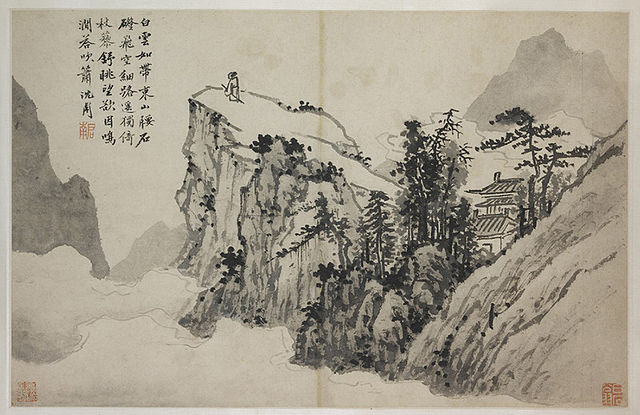
Han Shan (“Cold Mountain”) was a Chinese Buddhist figure associated with a collection of poems from the Tang Dynasty.  When he lived, who he was, and whether he existed is a mystery.

Apparently, he lived alone in an empty cave on Cold Mountain, following the Way, harmonizing with the eternal Tao, meditating. He spent his days in seclusion and simplicity, writing poems. 

Here is a sample of his work:

In my house there is a cave,                                                               

and in the cave is nothing at all —                                                   

pure and wonderfully empty,                                                 

resplendent, with a light like the sun

A meal of greens will do for this old body,                                          

a ragged coat will cover this phantom form.                                      

Let a thousand saints appear before me —                                          

I have the Buddha of Heavenly Truth.

Buddhism is an attempt to describe the Indescribable, to tell the Untellable, to fathom the Unfathomable, to say the Unsayable. Buddhism is a realization of Oneness. 

But beware of making Oneness an idea. It’s not something that can be rationalized, compartmentalized and categorized. 

Oneness is a reality that can only be experienced, intuitively, for each individual by himself or herself. 

Once a student said, “I’ve been reading that Jesus and Buddha were enlightened individuals, but their enlightenment was different.” 

That’s impossible.

Perhaps their expression of enlightenment was different, but not the actual experience. 

Enlightenment is a sudden, tacit understanding of the non-dual nature of reality. 

Oneness is One, not Two.  

That student was under the impression that in meditation something happens. You magically morph from monster to master. Meditation somehow transforms titmice into titans. 

The truth is, in meditation, nothing happens. 

In meditation, one realizes the Wallpaperness of Whatever-Is-Before-Your-Face, the Actual Sameness, the Perpetual Potential,  the Golden October Radiance, the This-Cannot-Be-Taught-ness.”

Words cannot go there. The tongue cannot touch it. To pollute Prajna with thoughts and labels and categories is to slander it.

The world is full of noise. Silence is the perfect sound.

If you want suffering, there’s plenty more where that came from. 

But in Buddhism, boredom is bliss. 

Someday, it will all end up on Cold Mountain, like Han Shan, in silence, in simplicity, in radiance, in bliss … in Oneness. 

And when that happens, despite whatever religion you follow, you too will have the Buddha of Heavenly Truth. 

Don’t Worry About A Thing

Volume 31. September 4, 2022

Monumental complainer Falstaff in Shakespeare’s Henry IV bellowed, “I were better to be eaten to death with a rust than to be scoured to nothing with perpetual motion!” 

In our fast-paced society, sometimes we all need a rest.  

Meditation provides serenity, peace, calm and tranquility.

But even during peaceful periods of meditation our minds seem to be “scoured to nothing with perpetual motion.” 

Thoughts, doubts, worries, anxieties, plans, schemes, agendas — there is no end to our demented deliberations and ruinous ruminations. Consciousness is a cacophony. 

Perhaps the most insidious parasite of peace is worry. 

As soothing summer shifts into agitated autumn, worry bugs nibble away at our repose. Preying on our mind, niggling away, bedeviling any balm, worry turn us into warts.

Spiritual giants have tackled this tough problem.

Jesus Christ advised, “Which of you by worrying can add a moment to your lifespan? Learn a lesson from the wild flowers. They neither spin nor sow, but I assure you that even Solomon in all his splendor was not arrayed like one of these.”

Rastafarian Bob Marley was more succinct. Bob sang, “Don’t worry about a thing. Oh, every little thing gonna be all right.” 

Jack Kerouac hit the nail on the head. “There’s nothing to worry about. And to worry about no-thing ain’t worry.”

Whatever we see, feel, hear, smell, taste, and think about resembles an illusion. We mistake a dream-like state for reality. We brood over this false reality.  Result: Continued suffering, anxiety, lost sleep, agony and unease … over nothing!

How can we get back to what is really real?

Meditate.

You don’t have to be a Buddhist monk or a zen master to be aware of your breath. 

Set aside dream-like thoughts of unreality. Banish the demons. 

Enjoy nirvana.

I asked my daughter if she is nervous about starting fourth grade. She fretted, “Yes. Last year some fourth grade boys went into the girls’ bathroom. It might happen again.”

Cute, but no-thing to lose sleep over. 

When we allow our minds to dwell on difficulty and troubles, we stew, brood and agonize. When we perceive that all things are empty, we return to peace.

Twenty-five centuries worth of Buddhist peace can’t be wrong. 

As Falstaff put it: 

“Hal, if I tell thee a lie, spit in my face, call me horse.”

Wisdom of the Lotus Sutra

Volume 30. August 2, 2022

The Lotus Sutra is one of the world’s great religious scriptures. Its influence on the history of Buddhism, like an ancient river, has been wide and deep.

The Lotus Sutra proclaims the transcendental nature of the Buddha (the Buddha is not only man, but a god) and the doctrine of universal liberation (we can all become Buddhas). 

It also spells out the bodhisattva path. 

A bodhisattva is literally one whose “being is enlightenment.”

The way to enlightenment comes from perfecting six virtues: generosity, patience, diligence, morality, meditation and wisdom. 

The Lotus Sutra is extensive, comprising twenty-eight chapters. One line from chapter five perhaps sums up the bodhisattva path, and distinguishes the character of a Buddha:

“Day and night he was at peace … meditating constantly.”

During the hottest, most uncomfortable dog days of summer, when the chirping grasshopper sits in the green grass and pours out his shrill song, when men are feeblest in the wearisome heat, 

“Day and night he was at peace … meditating constantly.”

During times of war when men, born to misery, see pink flesh separate from white bones, and woman in agony bring forth children to live as wretched things, 

“Day and night he was at peace … meditating constantly.”

During ceremonies condemning the treasonous, exposing the wicked for their greed, causing anger to rise in gentle hearts and eyes to burn with searing fire,

“Day and night he was at peace … meditating constantly.”

During treacherous storms, fatal floods, devastating droughts, furious fires scorching primordial trees, and terrible tornados tearing apart towns, while the innocent shed tears,  

“Day and night he was at peace … meditating constantly.”

A Prayer

Oh Bodhisattva, Guan Yin, the hearer and answerer of prayers, 

Oh Lord Buddha, the sweet Tathagata, 

Give us the grace to truly see that we are you, and you are we. 

Blessed be kindness. Blessed be love. 

Blessed be virtue. Blessed be children.

Blessed be ignorance. Blessed be wisdom.

Blessed be bodhi. Blessed be peace. 

Blessed be hearts overflowing with compassion. 

Adoration to the big, blank mind of the Buddha, 

The Lotus for troubled times. 

Amen

Song of Summer

American poet Emily Dickinson reveled in the bliss of summer when she wrote, 

Inebriate of air am I, 

And debauchee of dew

Reeling through endless summer days

From inns of molten blue. 

Drunk on the “Taste of a Liquor Never Brewed,” Miss Dickinson teaches us Buddhist wisdom. Enjoy the moment. Set aside conceptual thinking. Breathe. Focus on the here and now. 

Fresh air. Dewy grass. Idyllic summer skies, bright blue, cloudless, hinting at the infinite nature of heaven above. 

Oh, would it always be like this — always summer, always fruitful, always restful. No time of year offers greater richness, warmth and love of living. 

Lounging poolside, reading a good book, licking an ice cream cone, summer activities can hardly be called a waste of time.  

American philosopher Sam Keen characterized this time of year  best when he said, “Summer is when laziness finds respectability.” 

Summer is a seasonal license to relax, enjoy and live. 

Yet, alas, summer is fleeting. 

It’s here today and gone tomorrow.

We don’t want to let it go. 

Our greedy souls cry out, “Can’t we bottle up Miss Dickinson’s jugful of joy? Can’t we perpetuate summer? Can’t we continue our loafing life of leisure forever?” 

The good news is … we can! 

We can cheat Father Time and live in world where it is always July. We can enjoy the perfection of seasonal bliss every day of the year. 

How so? Meditate. 

Summer is external bliss. Mediation is internal bliss. 

Focus on the breath. Let go of thoughts. Return to the breath. Soon, all mental activity will come to rest. Relax in tranquility. 

Let worries go. Let troubles go. Let your “self” go. 

If you are wondering why you haven’t attained enlightenment yet, it’s because it’s the No Self that attains enlightenment. You already are a Buddha. But your “self” keeps hankering for it. 

Let it go. Be present to the moment. Be. Here. Now. 

The purpose of all the Buddhas is to emancipate “you” from the bondage of your thinking.

Meditation brings “you” back to your true origin: the No Self, Buddha-nature, the Inns of Molten Blue. 

Celebrate summertime everyday through the bliss of meditation. 

Summer is fleeting. The moment is eternal. 

Another Goodbye to Another Good Friend

Volume 28. June 6, 2022

Guitar god Keith Richards probably put it best when he sang:

“Here’s another goodbye to another good friend.”

The school year ended on a sad note in Uvalde, Texas. 

Blood splattered across blackboards. Traumatized survivors running for their lives. Frantic parents crying on the sidewalk. Screams of agony. Nineteen innocent children and two teachers robbed of life at Robb Elementary School.  

Another senseless spray of bullets. Another splattering of blood.

Another goodbye to another good friend.

How does a Buddha approach the horror of gun violence? 

With compassion, meditation and wisdom.  

For kids lamenting lost classmates, for parents aching for lost children, there is only one balm: compassion. Buddhas “suffer with” the disconsolate. 

Buddhas also meditate. 

The mighty Buddhist philosopher Ashvaghosa had this spiritual advice, “One’s mind should become like a mirror, reflecting things but not judging them or retaining them.”

When we meditate, we realize that nothing is right and nothing is wrong. Only thinking makes it so. 

Meditation and compassion are two legs upon which the liberating body of Buddhist wisdom stands. 

Wisdom is to look at the world and see emptiness. Return to the Holy Thusness. Stick with the Sweet Tathagata. One thing is sure: The Mind is pure. Nirvana can’t be separated from anything because everything is empty. 

Whatever the senses apprehend resembles an illusion. Entertain one thought or sensation and you abandon unity for duality. 

Suffering is the hallmark of the human condition. It’s what you signed up for when you chose to be reborn. 

Suffering exists only in duality. But there is a way out of suffering: Compassion, mediation and wisdom. 

Once upon a time, the Lord of Unity said, “Have compassion for this so-called world. It’s actually nothing.” 

Then he pronounced magic words, “Impermanence, Peace, Calm, Non-attachment, No-self.”

The magic words had a disconcerting effect on dictators, despots, shooters and self-centered people everywhere. But they had a salutary effect on everyone else. 

And the Lion lied down with the Lamb. 

Guitar Lion King Keith Richards sings at the end of his song:  

“I’m gonna find my way to heaven, ‘cause I did my time in hell.” 

Buddhas, we have done our time in hell. 

Let’s follow the path to nirvana, and hope others will too.

The Buddhist Perspective on Life

Volume 27. May 8, 2022

Mae West (1893-1980) was a stage and screen actress known for her breezy sexual independence and bawdy double entendres.

America’s first sex symbol once said in her mumbling, husky voice, “You only live once, but if you do it right, once is all you need.”

Surprisingly, the Buddha would agree.

Sex, life and death bring up a recent development in our land.

On May 3, 2022, the US Supreme Court leaked a draft opinion signaling the repeal of Roe v Wade. After 48 years, women may lose their right to a safe, legal abortion.

Setting aside the politics, the morality and the philosophical question (when does life begin?), now is a good time to examine the Buddhist perspective on life.

For a Buddhist, human life is precious.

The chance to be born a human being is an opportunity too valuable to waste.

In Buddhist understanding, there are six states of existence: gods, anti-gods, humans, restless ghosts, demons and animals.

Only human beings can gain enlightenment during their lifetime.

Despite a pain-free life of bliss, even the blessed gods can’t do it.

Thus, for a Buddhist, human life is too precious to be squandered.

It’s a rare opportunity for ultimate spiritual progress.

The Buddha teaches the way to enlightenment.

Follow the path of morality, meditation and wisdom.

Consider this story of Zen wisdom.

Once upon a time, there lived a Zen master. Every evening at low tide, he would walk along the seashore and fling back into the water any starfish that happened to wash up on the shore.

One evening, a novice approached and said, “What are you doing?”

The master replied, “Tossing starfish back into the sea.”

“Master, why are you doing that?”

“Well, if I don’t throw them back, they will die on the shore for lack of oxygen.”

The novice looked down the beach. His eyes goggled. There were hundreds of thousands of starfish littered across the sand.

He said, “Master, there must be a million starfish on this beach. You can’t get to them all. How can you possibly make a difference?”

The Master bent down, picked up a starfish and tossed it back into the sea.

Then he said, “Well, made a difference to that one.”

It doesn’t matter if you’re Mae West, a Zen master or a starfish. Don’t waste this precious opportunity called Life.

To the world you may be one person.

But to one person you may be the whole world.

Man’s Inhumanity to Man

Volume 26. April 11, 2022

One day after the slap heard round the world, on March 28, 2022, Will Smith apologized to Chris Rock. “My behavior at last night’s Academy Awards was unacceptable and inexcusable … I would like to apologize to you, Chris. I was out of line and I was wrong.”

Then why did you do it? 

At what should have been the pinnacle moment of his life, the zenith of his career, Will Smith soiled himself — in front of a live television audience totaling 16.6 million viewers. 

Unbelievable how the ego can sabotage one’s true self!

And yet, completely believable because that’s what the ego does. 

The ego exists for its own good. Not for the sake of other people. 

Buddhas come into the world to reorient the ego. Armed with shovels, searching for dung heaps, Buddhas shovel the filth of egotism out of our minds and proclaim the No Self. 

When one realizes that one’s innermost being is the No Self, then one’s actions become selfless, instead of selfish. 

Egocentric behavior becomes egoless behavior. 

Chris Rock had the proper response. Humility, forgiveness, turn the other cheek, don’t draw attention to the dark side of humanity, let it go, don’t press charges. Chris was Christ-like. 

He was not attached to his ego. 

Bodhisattvas are not attached to their egos. Bodhisattvas relieve the sufferings of the world. They lead people to enlightenment. 

We have all met a bodhisattva during our lifetime. Think of the kindest person you have ever known. Perhaps, a grandmother or a sainted aunt. That’s a bodhisattva.

The road to Buddhahood in Mahayana Buddhism is called the bodhisattva path. It consists of perfecting six virtues: generosity, patience, diligence, morality, meditation and wisdom. 

The bodhisattva path is the path of love.

The slap heard round the world was wrong on so many levels. It was not only a crime (battery), it was an affront to human dignity. Will Smith didn’t slap Chris Rock, he slapped us all. 

Multiply that slap by a billion-fold and you got a war in Ukraine. Violence, pride, ambition is not who we are. That’s our false self. Humility, anonymity, kindness, patience — that’s our true self.

Only one thing wins in the end — love. Remove the dam of the ego and the waters of love flow naturally. 

Love hides at the center of all things. At times like these, we need to let it shine. Then our times become Buddha times. 

The strength of evil is extremely intense, except for those with an enlightened mind.  

When we get the ego out of the way, and let the No Self take over, then the Oscar goes to … humanity.